|
<< Click to Display Table of Contents >> In Series with a Keyboard (Keyboard Wedge) |
  
|
|
<< Click to Display Table of Contents >> In Series with a Keyboard (Keyboard Wedge) |
|
This method allows the barcode scanner to act exactly like a keyboard.
| 1. | User must ensure SpecView is ready to accept keyboard entry. |
| 2. | Unsolicited keyboard entry |
1. Users Must Ensure SpecView Is Ready To Accept Keyboard Entry.
This can be done by touching the variable or it can be linked to a button.
For example, the operator clicks a 'Ready to Start' button which turns on a SpecView Boolean that is watched by the Strategy Controller. The actions:
GDW Control: Swap to another GDW
Parameters: Alter Value Interactively
set SpecView ready to receive keyboard or barcode input.
Alternatively, SpecView can support unsolicited keyboard entry from version 3.1.228 onwards by utilizing specific User Variables.
Create a unique Text User Variables and name it 'SVKeyboardEntryText'. The variable name is case sensitive. For additional help with creating User Variables, please read Variables List - SpecView Variables.
Click and drag SVKeyboardEntryText on to the GDW and enter Runtime Mode.
If the scanner is correctly connected to the PC and is functioning as expected, then SVKeyboardEntryText should display scanned values without any further user input.
However, when scanning multiple barcodes, SVKeyboardEntryText will append the most recent barcode to the end of the previous barcode as seen below.

Figure 1: SVKeyboardEntryText after scanning one barcode.

Figure 2: SVKeyboardEntryText after scanning two barcodes.
To prevent this from occurring, Strategy Controller must be utilized to implement a few lines of logic.
For information on programming Strategy Controller, please read Programming the Strategy Controller.
One possible way to circumvent the barcodes appending to the end is described below.
Create a Boolean. The User Variable must be named 'SVKeyboardEntryEnter'. The name is case sensitive.
If a <CR> (Carriage Return) or <LF> (Line Feed) character is scanned, then SVKeyboardEntryEnter will automatically be turned ON.
The end of a barcode usually contains a <CR> or <LF>.
SVKeyboardEntryEnter will not automatically turn OFF.
Create another Text User Variable. This variable can be named appropriately, for example 'LastBarcode'.
Create a Strategy Event that looks for SVKeyboardEntryEnter to turn ON. The actions for that strategy event should be as follows:
| • | Turn SVKeyboardEntryEnter OFF |
| • | Copy SVKeyboardEntryText to LastBarcode |
| • | Clear SVKeyboardEntryText by setting SVKeyboardEntryText to be a blank string. |
If done correctly, when a barcode is scanned, SVKeyboardEntryEnter will be ON. SVKeyboardEntryText will be populated.
Strategy Controller will notice that SVKeyboardEntryEnter is ON and turn SVKeyboardEntryEnter OFF, copy SVKeyboardEntryText to LastBarcode, and clear SVKeyboardEntryText.
At the end ...
LastBarcode will contain the value of the previously scanned barcode.
SVKeyboardEntryText will be blank and ready to be populated with the next barcode.
SVKeyboardEntryEnter will be OFF and will be ready to turn ON once a new barcode is scanned.
There is a video on SpecView's YouTube channel that illustrates this here: 7010 SpecView Version 3 Barcode scanner to Keyboard
As of SpecView version 3.1.275, it is now possible to have Remotes scan barcodes that can appear on the Local.
Users must repeat the steps in the section above, Unsolicited Keyboard Entry for every Remote with a few minor changes.
A quick summary of the steps are below.
| 1. | On the Local, create an additional Boolean User Variable and name it exactly as seen, “SVKeyboardEntryEnter _X”. |
| 2. | On the Local, create an additional Text User Variable and name it exactly as seen, “SVKeyboardEntryText_X”. |
| o | For help in creating User Variables, please read Variables List - SpecView Variables. |
| o | X is the name of the Remote connection. So, if the Remote connection was called Oven 1, then the name of the Text and Boolean parameters should be “SVKeyboardEntryText_Oven 1” and “SVKeyboardEntryEnter _Oven1”. |
| o | The name of the connection must be unique. There can not be multiple Remote connections with the same name. |
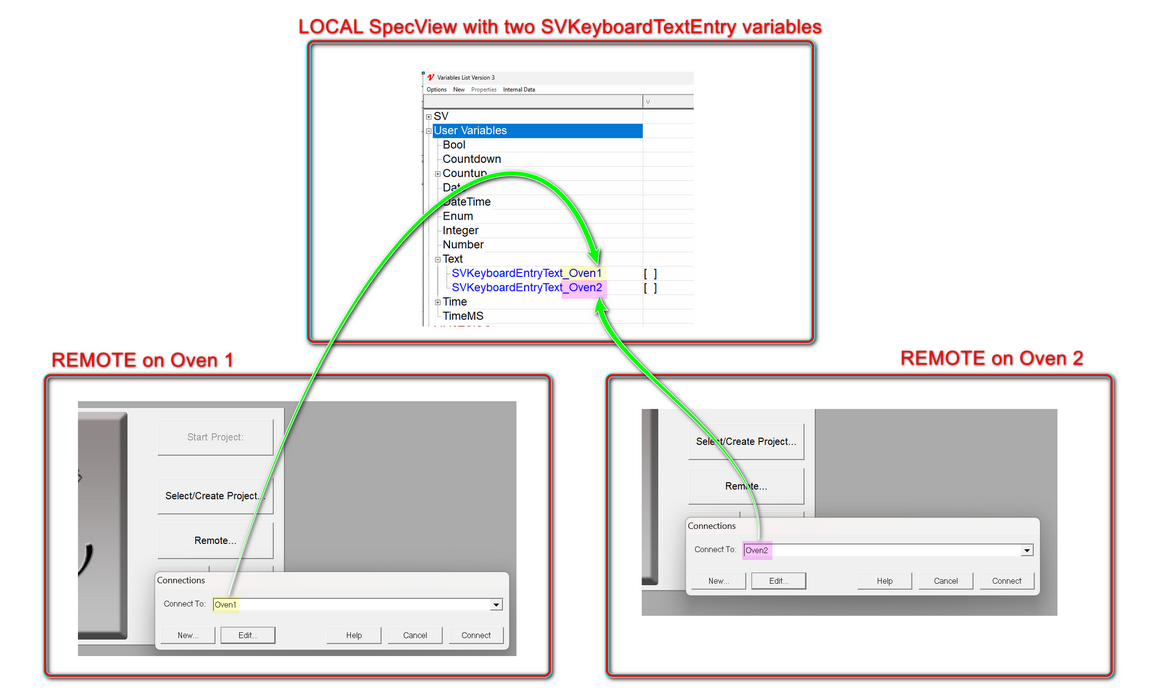
Now, given the barcode scanner is correctly connected to the Remote, then the barcodes being scanned on the Remote should appear on the Local.
If it does not appear on the Local, the check the following.
| • | The parameters are correctly named. |
| o | The connection name is correct. |
| o | There are no spelling mistakes or spaces at the beginning or end of the name. |
| o | There aren’t multiple Remote connections with the same name. |
| • | The barcode scanner is correctly connected to the Remote. |
| o | Try opening up a text editor like Notepad on the Remote and scanning a barcode to see if it appears in Notepad. |
If none of the above suggestions resolves the issue, please contact your SpecView representative.
Additionally, when scanning multiple barcodes, the SVKeyboardKeyboardEntryText_X will append the barcodes.
Please read through the above section on Unsolicited Keyboard Entry to see how Strategy Controller can be used to circumvent the appending of barcodes.
Whatever the section suggests in terms of Strategy Controller logic for SVKeyboardEntryText is applicable to SVKeyboardEntryText_X and needs to be implemented on the Local.